
NAM Neutral Perspective – A Conversation with Albert Rizzo, Esq.
NAM Neutral Perspective | November 24, 2026
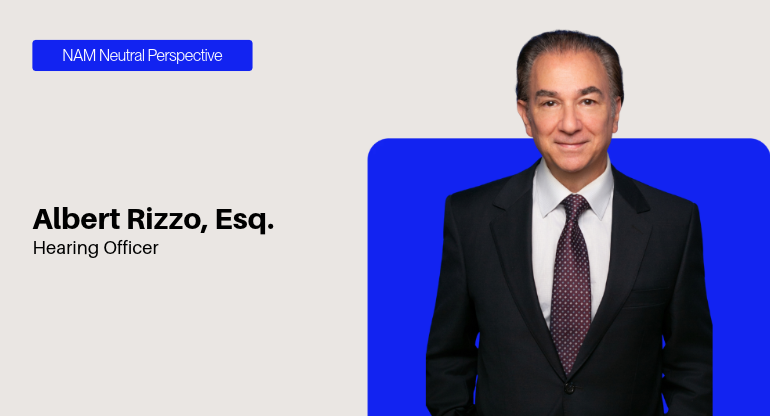
NAM is pleased to welcome Albert Rizzo, Esq. to its panel of neutrals, bringing nearly four decades of experience in commercial, employment, construction, real estate, insurance, and business disputes to NAM's clients. In this edition of NAM Neutral Perspective, we spoke with Mr. Rizzo about how his experience as a litigator, outside general counsel, and neutral in more than 200 matters shapes his approach to arbitration and mediation, how his work teaching dispute resolution, negotiation, and employment law informs his practice, his advice for attorneys preparing for mediation and arbitration, and what drew him to join NAM's panel.
You've spent nearly four decades representing businesses, executives, entrepreneurs, and individuals, and you've also served as an arbitrator, mediator, special master, and neutral evaluator in more than 200 matters. How does having seen disputes from both the advocate's side and the neutral's side shape how you handle a case today?
My background is in litigation, and I've litigated commercial cases on both sides. Because of that, I know where the parties are coming from, and I know what legal arguments they're going to make, or try to make. Having seen disputes from both sides, as an advocate and as a neutral, across all these matters and all these years, helps me better understand each side's position.
That understanding lets me structure a mediation or arbitration so that each side feels heard and feels they're getting a fair shake. If you don't understand where the parties are coming from and what their legal arguments are, you can't have the empathy to see things from their perspective. Without that, you can't have a fair process, because the parties shut down. Knowing these disputes from both the advocate's side and the neutral's side allows me to better shape the process.
Much of your practice has focused on employment law, from discrimination and wrongful termination to executive severance and whistleblower matters. These disputes often involve personal stakes and strong emotions. How do you create a balanced forum where both employers and employees feel heard?
Employment disputes are different from most commercial matters because the relationship between employer and employee is personal. A commercial case can carry plenty of emotion. A party may feel they were wronged to the tune of millions of dollars and be very emotional about it, but at the end of the day, that's business. In employment cases, there are often personal issues underneath the legal ones. The question may not be whether an employee is entitled to severance, but whether the severance is actually fair.
Because of that, I give the parties more time to speak than I might in a commercial case. Employees in particular need the opportunity to say everything they want to say about the relationship. Sometimes that goes beyond the immediate issue, like the reason for termination, and reaches back years, to years of feeling mistreated or feeling discriminated against in some way. Letting them be heard is an important part of creating a balanced process.
The parties also don't always come to the table in the same circumstances. Sometimes an employee isn't represented by counsel and is appearing pro se. In those cases, I take extra care to make sure they understand the process and have a full opportunity to present their side, so that both parties can participate fully.
As outside general counsel to closely held businesses and emerging companies, you've advised clients on how to avoid disputes, not just how to resolve them. How does that understanding of how and why conflicts arise help you guide parties toward creative solutions that go beyond what litigation can offer?
My experience as general counsel taught me to treat litigation as a business proposition, and that's how I encourage parties to approach their disputes. In most commercial cases, the dispute comes down to money. The question is whether continuing to litigate makes financial sense. What are the costs and benefits, and what does each side realistically stand to gain? Very often, the answer is that it doesn't make sense to keep going.
I learned that lesson early in my career. I was trying a commercial case that had been going on for years, and on the eve of trial, with the jury about to be called in, the judge asked whether we had discussed settlement. Neither side had. This was before ADR became widely used. He advised us to go settle the case, because in the commercial division it's always about money, and there's always a price tag on settlement. Very few disputes raise the kind of constitutional question that needs to go to the Supreme Court. Most come down to a practical business decision.
When parties start thinking about their dispute as business people, creative solutions often follow. Instead of focusing on winning, they begin to consider what they can afford to give up and what they want in return. They also look at the cost of continued litigation, and that is often what opens the door to resolution.
You teach negotiation, mediation, and conflict management at New York Law School and NYU. What advice would you give attorneys preparing for mediation or arbitration to make the process as productive as possible?
My first piece of advice is simple: be prepared. As the neutral, I prepare thoroughly for every mediation and arbitration, and I expect the same from counsel. Very often, though, attorneys aren't prepared enough, or they aren't prepared in the right way.
A common example is litigators who come to a mediation ready to try their case, as if it were a trial or an arbitration. That isn't the purpose of mediation. Mediation is a negotiation, and too often attorneys arrive without a negotiation strategy, either because they don't know how to build one or because they haven't taken the time to do so. Preparation means more than reading through the papers the day of. It means walking in with a clear plan for how to negotiate a resolution. That's the first thing I teach my students, and it's the first thing I tell parties.
I understand the pressures that can pull against ADR. As a litigator myself, I know attorneys are hired to try cases and win them. But if a party has no real intention of resolving the matter, it's better to say so at the outset than to go through the process unprepared and use up the time of the neutral, the other side, and their own client. In my experience, I can usually tell within the first few minutes whether the parties are ready to engage. Whatever the setting, counsel needs to be prepared for the process they're actually in.
What drew you to join NAM's panel, and what do you hope to bring to parties and counsel as a NAM neutral?
NAM is an excellent organization with a roster of highly qualified arbitrators and mediators, and joining its panel is something I've wanted for a long time. I consistently hear good things from lawyers who have used NAM's neutrals and were happy with the experience. That says a lot. Like any business, repeat business comes from people who are satisfied with the service.
As for what I hope to bring, I want parties and counsel to know that I'm prepared, that I'm fair, and that I'm open to hearing them. That applies to arbitration as much as mediation. Some arbitrators go in thinking their role is only to decide the case. Ultimately it is, but it's also about giving the parties the opportunity they need to present their cases. I hope the parties and attorneys who appear before me see me as someone who is prepared, fair, and willing to listen.
About Albert Rizzo, Esq.
Albert Rizzo, Esq. is an arbitrator and mediator with nearly four decades of experience across complex commercial, employment, construction, real estate, insurance, and business disputes. As principal attorney of the Law Offices of Albert Rizzo, P.C. since 1996, he has represented businesses, executives, entrepreneurs, professionals, and individuals in state and federal courts, administrative proceedings, arbitrations, and mediations, and serves as outside general counsel to closely held businesses and emerging companies on contracts, corporate governance, employment practices, and dispute avoidance. His employment law experience spans discrimination, harassment, wrongful termination, wage and hour, retaliation, executive employment, severance, whistleblower, and labor relations matters. Before founding his practice, Mr. Rizzo spent nine years as an attorney at Jacobs Persinger & Parker. He has served as an arbitrator, mediator, special master, and neutral evaluator in more than 200 matters, ranging from small claims to multimillion-dollar disputes. Mr. Rizzo is an Adjunct Professor of Law at New York Law School and has taught at New York University's Graduate School of Professional Studies since 2011. Mr. Rizzo is available to arbitrate and mediate cases throughout New York.
About NAM
NAM is a premier provider of Alternative Dispute Resolution (ADR) services, delivering efficiency and results to clients throughout the U.S. and globally. Through its market-leading technology and secure virtual and hybrid forums, NAM offers a streamlined alternative to traditional litigation. With an exceptional roster of neutrals and concierge-level case administration, NAM is the ADR partner of choice for over 10,000 commercial entities and half the Fortune 100.