
NAM Neutral Perspective – A Conversation with Judge Spodek
NAM Neutral Perspective | April 29, 2026
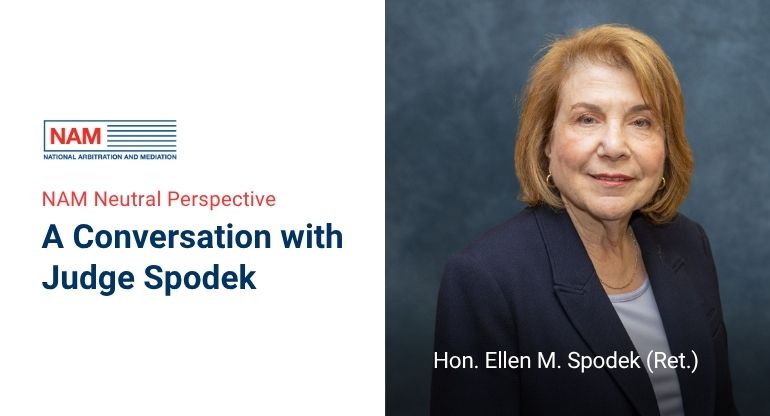
NAM Neutral Perspective – A Conversation with Judge Spodek
NAM has welcomed the Hon. Ellen M. Spodek (Ret.) to its panel of neutrals, bringing her impressive background and decades of judicial experience to NAM's clients. In this edition of NAM Neutral Perspective, we spoke with Judge Spodek about her practical and collaborative approach to mediation and arbitration, her strategies for navigating complex, high-stakes disputes, and her commitment to fostering trust, candid dialogue, and timely, equitable resolutions.
Having presided over more than 1,000 medical malpractice matters, what insights do you bring to mediating or arbitrating technically complex cases?
I bring both a deep familiarity with complex medical issues and a practical understanding of how those issues are ultimately evaluated by a jury. First and foremost, I focus on ensuring that each side can clearly and effectively explain their case. These matters are often highly technical, and the ability to translate complicated medical concepts into a persuasive narrative is critical. In addition, my years on the bench allow me to provide meaningful perspective on how jurors are likely to perceive the evidence and the overall story each side presents. That insight can be invaluable in helping parties realistically assess risk and exposure. I also draw on my experience managing expert testimony and conflicting medical opinions to identify the true points of dispute and move the conversation toward resolution.
You conducted daily settlement conferences for nearly two decades. What strategies have you found most effective in helping parties move toward resolution?
I typically begin by bringing the parties together so each side can present its position directly. That initial joint session often helps clarify the issues, humanize the dispute, and ensure that both sides feel heard. From there, I move into break out rooms, which allow for more candid and productive discussions. In those sessions, I work with each party to realistically assess both the strengths and vulnerabilities of their case, while also anticipating how the opposing side is likely to respond. This helps shift the focus from positions to risk evaluation and practical outcomes. Equally important is building trust. I make it clear that confidentiality is paramount and that nothing will be shared without express permission. When parties feel confident that they can speak openly, it creates the conditions necessary for meaningful negotiation and, ultimately, resolution.
You served as Supervising Judge of the Civil Court of Kings County, overseeing numerous judges while maintaining your own docket. What leadership lessons from that role continue to inform how you guide parties and counsel in ADR proceedings?
My experience as Supervising Judge reinforced that effective leadership begins with establishing trust and understanding what each person needs to move forward. When I was overseeing judges with demanding caseloads, I would ask what support they needed to manage their dockets more effectively. That collaborative, problem-solving approach is something I carry directly into my ADR work. In mediations and arbitrations, I take a similar approach with the parties and counsel. I focus on understanding their concerns, expectations, and underlying interests, and I help reframe issues in a way that promotes productive dialogue. For example, it may involve helping a physician better understand a patient's perspective, or assisting counsel in seeing how certain arguments may be received. Ultimately, my role, whether as a supervising judge or a neutral, is to create an environment where all participants feel heard, supported, and guided toward a practical resolution.
What advice would you offer attorneys preparing for mediation or arbitration to make the process as productive and efficient as possible?
Preparation is critical to making any mediation or arbitration productive and efficient. From the outset, counsel should clearly communicate to the neutral what they believe are the most important aspects of their case. That may be done privately, outside the presence of the adversary, but it is essential to lead with your strongest points so the neutral can quickly understand the core issues. Equally important is having a comprehensive command of both your case and your opponent's. You should understand not only your strengths, but also your vulnerabilities and have a thoughtful strategy for addressing them. That includes thoroughly reviewing the record and being fully aware of what information the other side has obtained or is seeking. I also encourage attorneys to pay close attention to what the opposing side is pursuing in discovery, such as subpoenaed materials. Even if something does not initially appear relevant, it often signals what the other side views as significant. Taking the time to analyze those signals can provide valuable insight and better position you for a successful resolution.
What drew you to join NAM's panel, and what do you find most meaningful about helping parties resolve disputes in an ADR setting at this stage of your career?
I was drawn to NAM because of its strong reputation within the legal community. In speaking with colleagues who had worked with or appeared before NAM neutrals, the feedback was consistently positive. When I began my own conversations with the organization, I found the team to be highly professional, respectful, and aligned with the values I believe are essential to effective dispute resolution. It quickly became clear that NAM was the right fit.
At this stage of my career, I find it especially meaningful to help parties resolve disputes in a more efficient and constructive forum. The reality is that, in many jurisdictions, it can take several years for a case to reach trial. ADR offers an opportunity to avoid those delays and achieve a resolution that is both timely and fair. That is particularly important in matters such as medical malpractice, where prolonged litigation can be difficult for all involved. Being able to guide parties toward a thoughtful and equitable resolution is both professionally rewarding and impactful.
About Judge Spodek
The Hon. Ellen M. Spodek (Ret.) brings over two decades of judicial experience to her mediation and arbitration practice, offering a distinguished track record of resolving disputes across a wide range of civil matters. As an elected Justice of the New York State Supreme Court in Kings County, Justice Spodek oversaw complex civil litigation and decided discovery motions in the Central Compliance Part. She is highly regarded for her deep subject-matter expertise in high-value torts and professional liability, having presided over the Medical Malpractice Trial Readiness Part and managed more than 1,000 medical malpractice matters. She is a member of NAM's (National Arbitration and Mediation) Hearing Officer Panel and is available to arbitrate and mediate cases throughout the New York Metro area.
About NAM
NAM is a premier provider of Alternative Dispute Resolution (ADR) services, delivering efficiency and results to clients throughout the U.S. and globally. Through its market-leading technology and secure virtual and hybrid forums, NAM offers a streamlined alternative to traditional litigation. With an exceptional roster of neutrals and concierge-level case administration, NAM is the ADR partner of choice for over 10,000 commercial entities and half the Fortune 100.